Spring has arrived, bringing with it one of the Lowcountry’s most cherished seasonal delicacies, soft-shell crab.

From April to June, warming waters trigger local blue crabs to begin both their breeding and molting processes. As they grow, they shed their outer shells, leaving them temporarily soft and entirely edible. This period is also crucial for females, as they mate only once during their final molt, when they are in their soft-shell state. This brief window of tenderness makes soft-shell crabs a sought-after treat, eliminating the need to crack through a hard shell to enjoy their sweet, delicate meat. For seafood lovers, soft-shell crabs provide a uniquely flavorful experience that embodies the season.
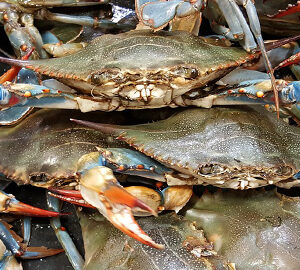
The blue crab (Callinectes sapidus), meaning “savory beautiful swimmer,” is known for its striking coloration and adaptability. Males, known as ‘Jimmies,’ have bright blue claws, while mature females, or ‘sooks,’ display orange or red-tipped claws. Males typically grow larger, reaching up to ten inches across. As they mature, males retain a T-shaped abdomen. Females transition from a triangular shape to a rounded form after their final molt.
Blue crabs must shed their hard exoskeletons to grow, with smaller crabs molting every few days and larger ones every 20 to 50 days. A few days before molting, a narrow white line appears on their swimming legs, which gradually turns red just before shedding. The molting process itself takes only minutes, during which the crab pushes out of its old shell. The newly molted crab is soft, limp, and swells by 25–35% before hardening over the next few days.
Mating occurs in brackish water starting in March and lasting through November, with spawning peaks taking place March through July.
Blue crabs mate in low to moderate salinity waters following an elaborate courtship ritual. A male pairs with a female about to undergo her final molt, cradling and carrying her until she sheds her shell. Mating occurs while she is still soft, and the sperm transferred by the male is stored in her body, allowing her to fertilize eggs over the next one to two years.
In early April, a “run” of peeler crabs can last about two weeks. Fishermen use “peeler pots” with large males to attract females ready to molt and mate, keeping them in shedding tanks until they molt. Once shed, soft-shell crabs are quickly refrigerated and sold, prized for their delicate, flavorful meat. South Carolina’s soft-shell crab industry remains underexploited but holds significant economic value for certain operators. Because soft-shell crabs are both difficult to collect and highly sought after in culinary markets, they command premium prices.
Beyond their biological significance, blue crabs play a vital role in both the commercial and recreational fishing industries.
Before 1975, soft-shell crabs were primarily a byproduct of the hard crab fishery. They made up 5% or less of the total catch. Over the past 20 years, however, the industry has grown in both size and value. Crabbers separate pre-molt “peeler” crabs, mainly females, from their catch and sell them to dealers who keep them in tanks until they molt. In South Carolina, harvesting and processing soft shell crabs under five inches is legal with a permit. Specialized gear, such as baited pots that attract pubertal-molt females and habitat traps that provide shelter, has improved harvesting efficiency. The availability of premolt crabs is influenced by water temperature and lunar phases. Peak harvests occur in April-May and a secondary peak in September-October.
By Kathleen McMenamin, Master Naturalist